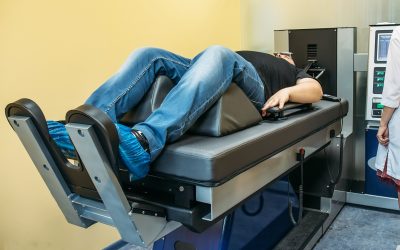
Hip pain that appears mainly during the first few steps after standing can indicate that the hip, pelvis, surrounding muscles, or nearby joints are reacting to the transition from rest to movement. The pattern may reflect stiffness, altered joint mechanics, muscle tension, or another musculoskeletal issue that becomes more noticeable when weight is first placed through the area.
For some people, the discomfort fades after several steps. For others, it gradually increases as they continue walking. That difference can provide useful information during an evaluation.
Why Can Hip Pain Be Worse Right After Standing?
When a person sits for an extended period, the hip remains in a flexed position and the surrounding muscles and joints move less.
Standing suddenly changes those demands. The hip must extend, support body weight, and coordinate with the pelvis, lower back, and leg as walking begins.
If the area is stiff or irritated, those first movements may feel uncomfortable.
A chiropractor for hip pain may ask how long the person was sitting before symptoms appeared and whether the discomfort improves after the first few steps or continues with activity.
That timing can help clarify how the hip responds to movement.
Does Stiffness Play a Role?
It can.
Stiffness is one possible reason pain feels strongest when movement resumes after rest. Muscles, joints, and connective tissues may feel less mobile after sitting in one position for a long time.
Once walking begins, movement may gradually become easier.
This pattern is sometimes described as “start-up pain,” where the first few steps feel more difficult than later ones.
However, stiffness alone does not identify the cause. Hip pain chiropractic evaluation should consider the overall pattern rather than assuming the problem comes from one structure.
Could the Pelvis or Lower Back Be Involved?
Yes.
Hip discomfort does not always originate entirely from the hip joint itself. The pelvis and lower back can influence how weight is transferred through the hips during standing and walking.
If spinal or pelvic movement is limited, one side may compensate more than the other.
This can make pain feel as though it is coming from the hip even when several areas are contributing to the problem.
A hip chiropractor may therefore assess the lower back, pelvis, hip movement, and surrounding muscles rather than looking at the painful area in isolation.
Why Does It Matter If the Pain Improves After a Few Steps?
Pain that eases after movement can provide useful clues.
If symptoms are strongest when a person first stands but improve after walking, stiffness or movement-related factors may be involved.
On the other hand, if pain continues to build with each step, the provider may consider different possibilities.
The direction of change matters.
Patients should pay attention to whether the discomfort fades, stays the same, or worsens during continued walking. Those details can help guide chiropractic treatment for hip pain.
What If Hip Pain Happens After Sitting for a Long Time?
Prolonged sitting can make this pattern more noticeable.
People may experience discomfort after working at a desk, driving, watching television, or sitting through a long event.
The amount of time spent sitting before symptoms appear can also be useful information.
For example, pain that develops after ten minutes may present differently from discomfort that only occurs after sitting for several hours.
A healthcare provider may also ask whether changing chair height, sitting position, or posture affects the symptoms.
Can Muscle Weakness or Tightness Contribute?
They can.
Muscles around the hips and pelvis help stabilize the body during standing and walking. If certain muscles are weak, tight, or not coordinating well, the first few steps after standing may feel uncomfortable.
The gluteal muscles, hip flexors, and surrounding stabilizers all play a role in controlling movement.
A chiropractor may evaluate strength, range of motion, and movement quality to see whether muscle function appears to be contributing.
This type of assessment can help determine whether chiropractic care should include mobility work, exercises, adjustments, or another approach.
What Should a Chiropractor Evaluate?
A chiropractic evaluation may include several factors:
- Where the pain is located
- Whether it affects one or both hips
- How long the person has been sitting before symptoms appear
- Whether pain improves after walking
- Whether stairs, bending, or getting into a car causes similar discomfort
- Whether lower back pain is also present
- Whether there is stiffness, weakness, numbness, or tingling
These details help create a clearer picture of how the hip behaves during movement.
Herfindahl Chiropractic provides care for people looking for a chiropractor for hip pain in San Diego, with treatment based on the individual findings rather than on the symptom location alone.
Does Hip Pain Always Need Chiropractic Treatment?
No.
Hip pain can have many causes, and chiropractic treatment may not be appropriate for every case.
Some patients may benefit from conservative chiropractic care, while others may require medical imaging, orthopedic evaluation, or another type of healthcare.
Sudden severe pain, inability to bear weight, visible deformity, significant swelling, fever, or symptoms following major trauma should receive prompt medical attention.
The goal of an evaluation is to determine the most appropriate next step.
What Can Patients Track Before an Appointment?
Tracking symptom patterns can make an evaluation more useful.
Patients may want to note how long they were sitting before pain appeared, which side hurts, how many steps it takes for symptoms to improve, and whether certain chairs or positions make the problem worse.
It can also help to record whether similar pain occurs when getting out of bed, rising from a couch, or standing after driving.
For people in San Diego dealing with recurring hip discomfort, these observations can help distinguish a consistent movement pattern from a more unpredictable problem.
When Should First-Step Hip Pain Be Evaluated?
Hip pain that repeatedly appears after standing, interferes with walking, or becomes more frequent should be evaluated.
Even when the discomfort improves after several steps, a recurring pattern may indicate that the hip, pelvis, lower back, or surrounding muscles are not moving or tolerating load as comfortably as they should.
A careful chiropractic evaluation can help identify which factors may be contributing and whether chiropractic care, movement strategies, or another treatment approach may be appropriate.